

Quick answer: Yes. Many women apply estriol cream to the neck and chest (the décolletage) by simply extending their estriol face cream a few inches lower, morning and night. Because skin there is thin and sensitive, start slowly, apply to clean, dry skin, and talk with your healthcare provider before starting any hormone-based cream.
You finally found a skincare routine that works for your face. Your skin looks calmer, softer, more like yourself. Then you catch your reflection in a car window, or in a photo from a dinner out, and your eyes go straight to your neck.
If this sounds familiar, you're not imagining it. The neck and chest often show change before the face does, and they're the two areas most routines skip.

Why the neck and chest show aging first
The skin on your neck is thinner than the skin on your cheeks, and it has fewer oil glands. It moves every time you turn your head or look down at a phone. Your chest gets years of sun that your face, shaded by hats and sunscreen, often doesn't.
Then midlife adds another layer. Estrogen helps skin hold on to moisture and collagen, so as levels fall during perimenopause and menopause, many women notice skin that feels drier and looks thinner. Cleveland Clinic describes how estrogen supports skin thickness, hydration and elasticity, and how those change after menopause.
On the neck and chest, that shows up as:
- Fine horizontal lines on the neck (sometimes called "tech neck")
- Crepey, papery texture on the chest
- Skin that looks less firm, especially when you lean forward
- Dryness that regular body lotion doesn't seem to fix
Many women experience this and assume it's just sun damage. Sun plays a role, but so do hormones. That's why a cream made for your face alone often isn't enough.
What estriol does for skin
Estriol is one of the three main forms of estrogen your body makes. It's the gentlest of the three, which is why it's the form most often used in topical skincare.
In a cosmetic cream, estriol is used to help skin look and feel:
- More hydrated and supple
- Smoother, with softer-looking fine lines
- Firmer and more even
A common misunderstanding is that a richer moisturizer will do the same job. Moisturizers sit on top of the skin and help hold water in. Estriol skincare is chosen by women who want to address the hormone side of the change, not just the dryness. The two work well together.
If you're new to estriol, our post on how to use estriol face cream in your daily routine covers the basics.
How to apply estriol cream to your neck and chest
- Start with clean, dry skin. Apply after your evening shower or cleanse, once skin is fully dry. Damp skin can make a cream spread unevenly.
- Use a small amount. You don't need a separate pump for each area. Many women divide a single pump between face, neck and chest. Follow the directions on your product label and your provider's guidance for how much to use.
- Use upward strokes. Smooth the cream from the base of your neck up toward your jaw, and outward across your chest. Gentle pressure is plenty. Pulling or tugging this thin skin doesn't help.
- Patch test first. Try a small amount on one side of your neck for a few nights before using it everywhere. Skip any area with broken, irritated or sunburned skin.
- Wash your hands and let it absorb. Wash your hands afterward and give the cream time to absorb before you get dressed or go to bed. Hormone creams on the chest can transfer through skin-to-skin contact, so avoid close contact with partners, children and pets until it has fully absorbed.
Can you use estriol and retinol on your neck?
You can, but go slower than you would on your face. Retinol helps skin look renewed, and it can also cause dryness and redness on thin skin. Many women alternate nights at first, or use a cream that combines both in one gentler formula.
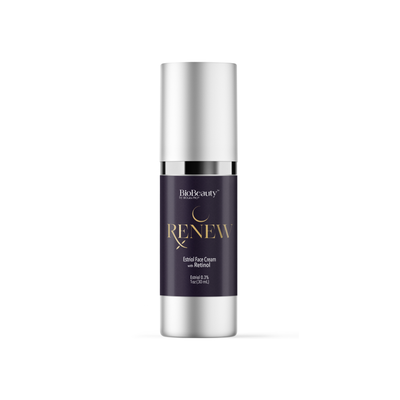
Our BIOBeauty Renew Night Cream pairs 0.3% estriol with retinol for evening use. If you'd like to understand how the two compare, read Estriol vs Retinol: Which Is Better for Anti-Aging and Sensitive Skin?
Whichever you choose, use sunscreen on your neck and chest every morning. Retinol makes skin more sensitive to sun, and your chest is one of the most sun-exposed areas you have.
Which BIOBeauty estriol face cream to choose
Our BIOBeauty face creams are made for the face, neck and chest, and they're designed to work as a day and night pair.
- BIOBeauty Revive Day Cream: 0.3% estriol with vitamin C and hyaluronic acid. Lightweight and non-greasy, so it layers well under sunscreen and makeup in the morning.
- BIOBeauty Renew Night Cream: 0.3% estriol with retinol, vitamin E and hyaluronic acid. Made to be the last step of your evening routine.
Many women use both: Revive in the morning, Renew at night. You can see the full line in our BIOBeauty collection.
The shift that matters most here is small: from treating your neck and chest as an afterthought to giving them the same care as your face. Most women who make that change say it's the easiest part of their routine to keep.

A gentle next step
If your neck and chest have started to look older than you feel, you don't need a complicated new routine. Start with one small change: take the cream you already trust a few inches lower.
Ready to care for your neck and chest?
Explore BIOBeauty Revive and Renew, our 0.3% estriol face creams for day and night.
These statements have not been evaluated by the FDA. BIOLabs PRO cosmetic creams are not intended to diagnose, treat, cure or prevent any disease. Talk with your healthcare provider before using hormone-based products.
Sources
Author Bio
Elizabeth Lopez has been a dedicated member of the BIOLabs PRO team since 2016, specializing in research and educational content focused on bioidentical hormones and holistic wellness. With nearly a decade of hands-on experience within the bioidentical hormone industry, Elizabeth stays current on emerging research, regulatory updates, formulation advancements, and patient education trends.
Working closely with formulators, pharmacists, and hormone-focused practitioners, she translates complex hormone science into clear, practical guidance for both providers and individuals seeking balanced wellness solutions. Her writing reflects BIOLabs PRO’s commitment to responsible education, ingredient transparency, and compliance-driven communication.
Elizabeth is passionate about empowering readers with research-informed insights that support informed conversations between patients and their healthcare providers.
Frequently Asked Questions
Is estriol cream safe to use on the neck?
Many women use estriol cream on the neck without problems, but neck skin is thin and can be sensitive. Patch test first, use a small amount, and talk with your healthcare provider before starting any hormone-based cream.
How long does it take to see results on the neck and chest?
Skin renews itself over several weeks, so most women give a new routine at least 6 to 8 weeks of consistent use before judging it.
Should I apply estriol cream in the morning or at night?
Both can work. A lightweight day cream like Revive fits your morning routine under sunscreen. A cream with retinol, like Renew, belongs at night, because retinol makes skin more sensitive to sun.
Can I use my face cream on my neck?
Yes. If your face cream contains estriol, you can extend it down to your neck and chest. Just divide your usual amount rather than adding extra.